Adding Tone Controls for the Passive Mode of an Active PJ Bass
Posted 2026/06/07. Last updated 2026/06/29.
Introduction
In a previous post, I described how I added a passive mode to my active bass using a push-pull potentiometer which combines a regular potentiometer with a Double Pole Double Throw (DPDT) switch. I have been quite satisfied with the passive mode so far, but, in its current form, it lacks the ability to alter the tone (other than pickup selection), and therefore feels somewhat limiting. My bass has two tone knobs in active mode (for treble and bass), and I wanted to be able to use them in passive mode, but without affecting the active side at all. As a result, simply soldering a capacitor to the tone pots and calling it a day was not sufficient for my purposes.
Adding Custom Dual-Gang Potentiometers
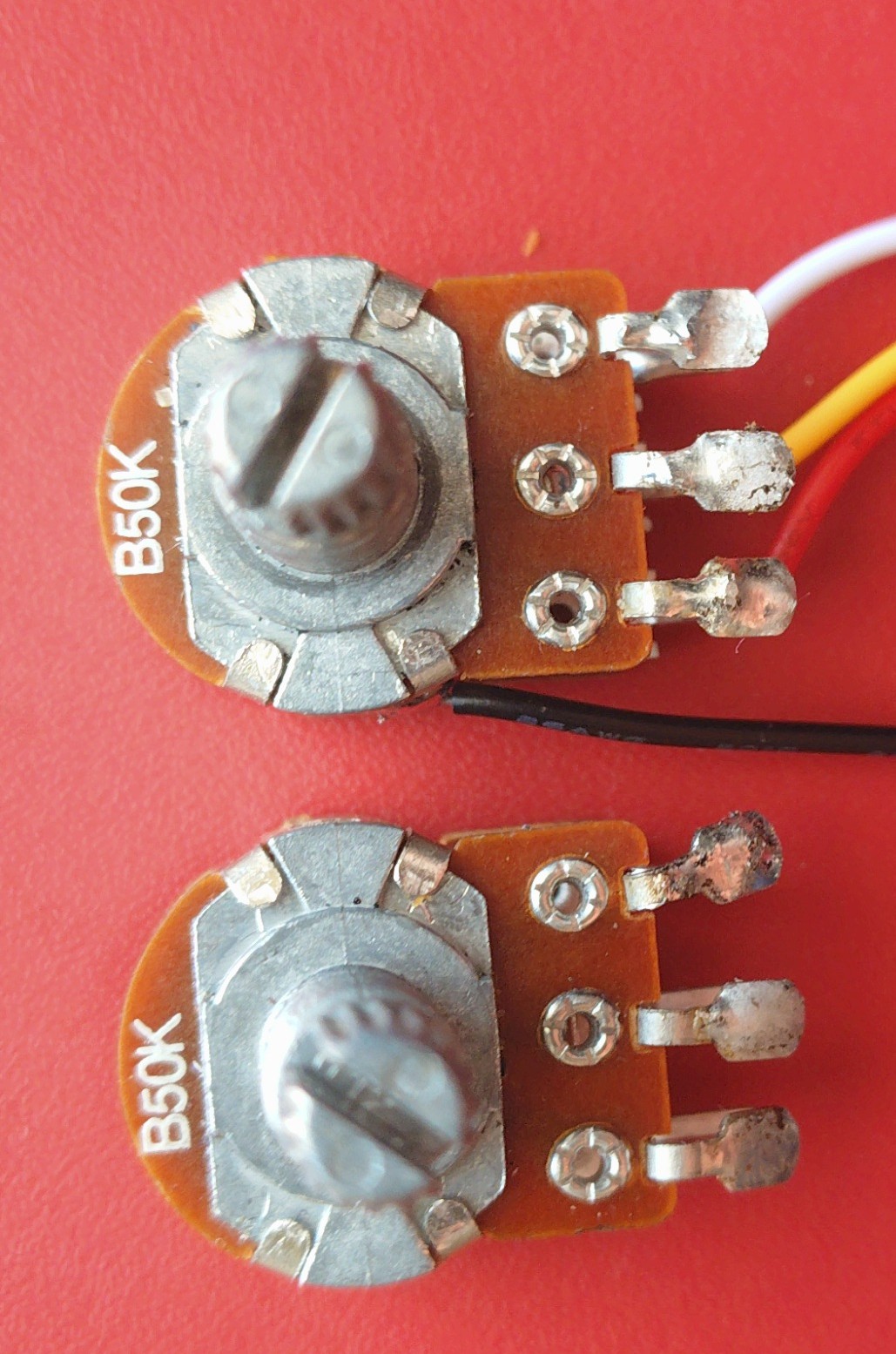
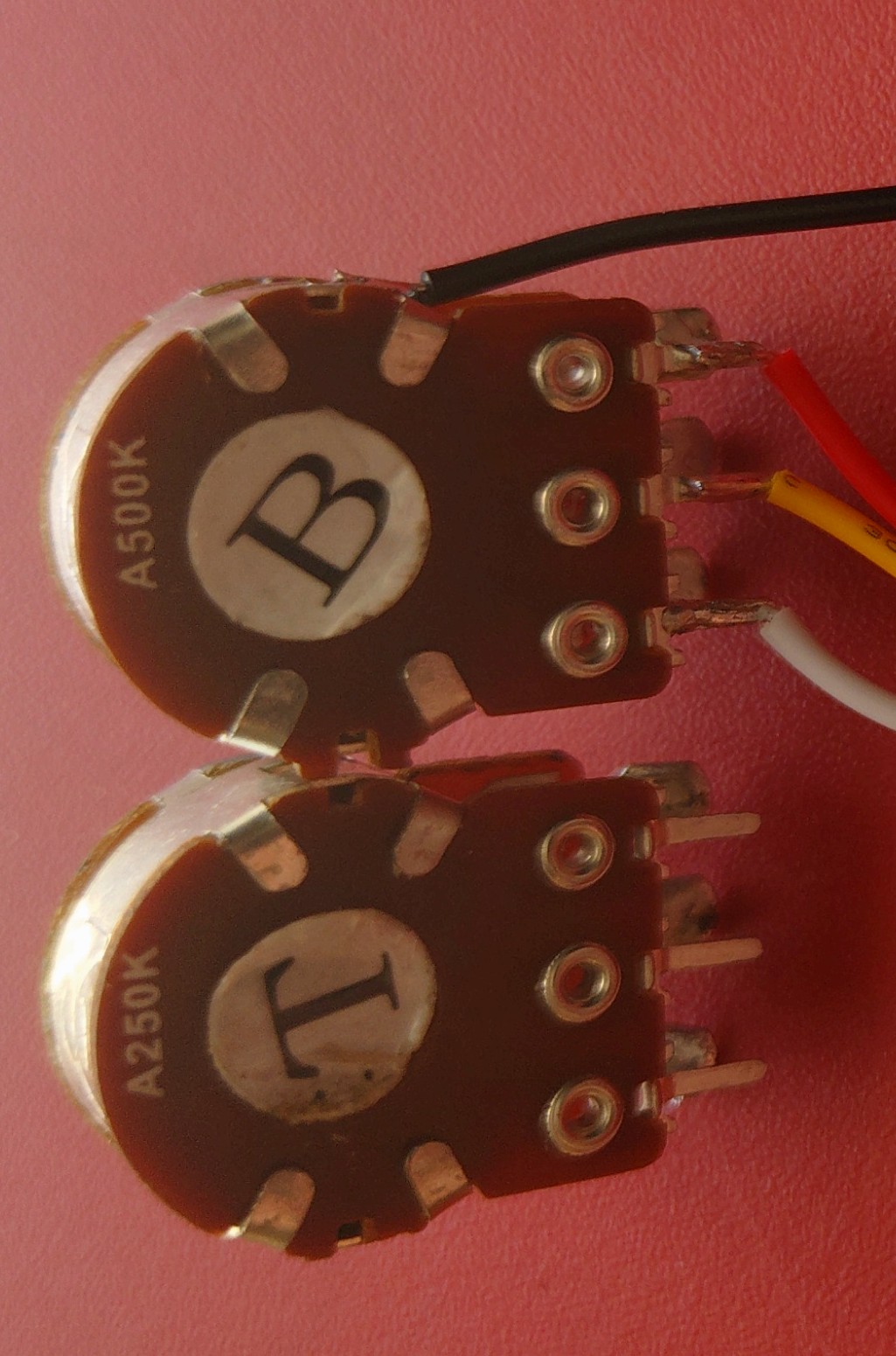
The first step was to replace the B50k tone control pots with dual-gang versions so that the passive and active circuits can be independent. Even though it is quite easy to find dual B50k pots, finding ones that are B50k on one side and logarithmic (A) on the other is more challenging or a lot more expensive (e.g., here and here). I instead decided to make my own by combining the existing B50k pots with a A250k dual-gang one for treble control and a A500k one for bass control:
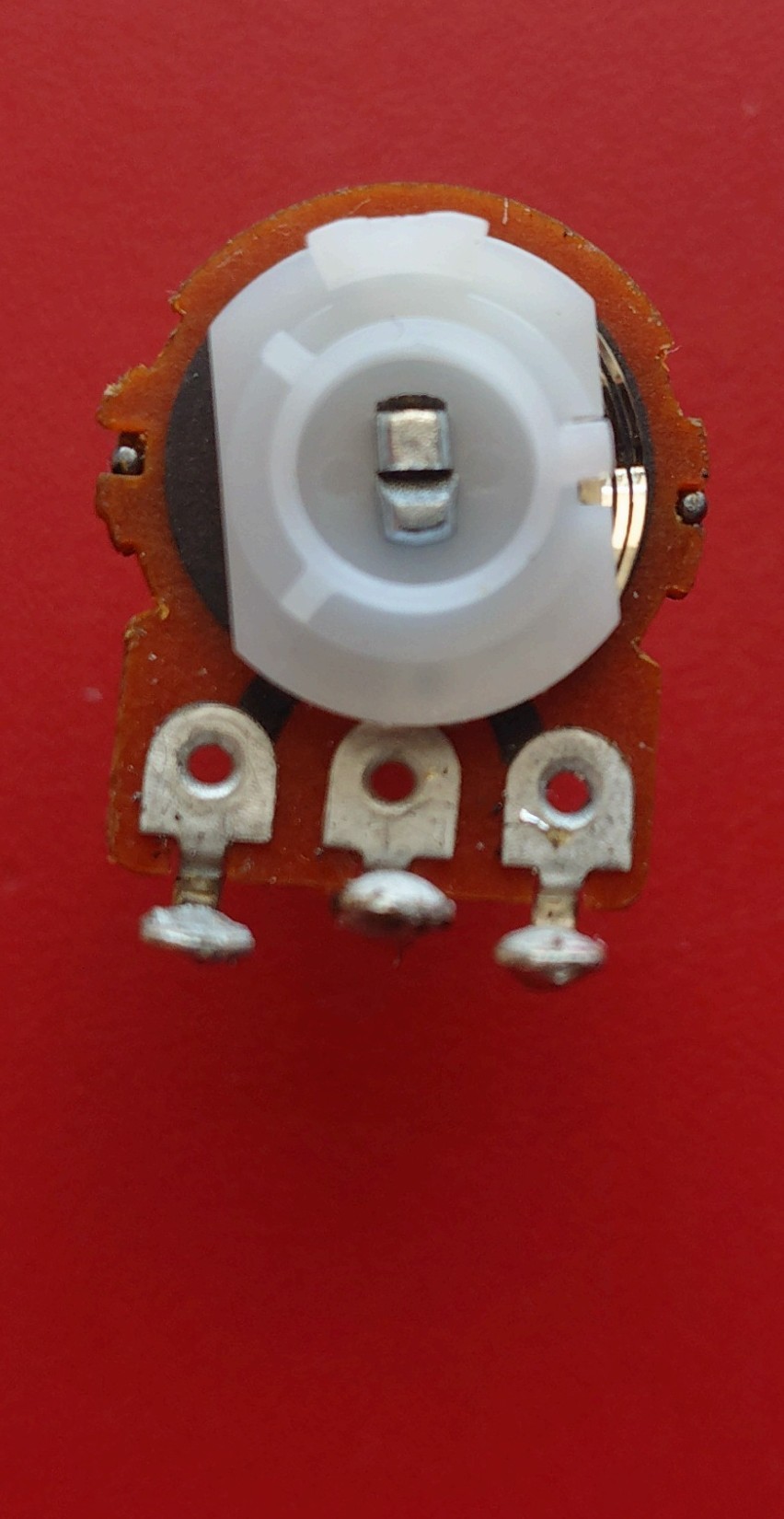
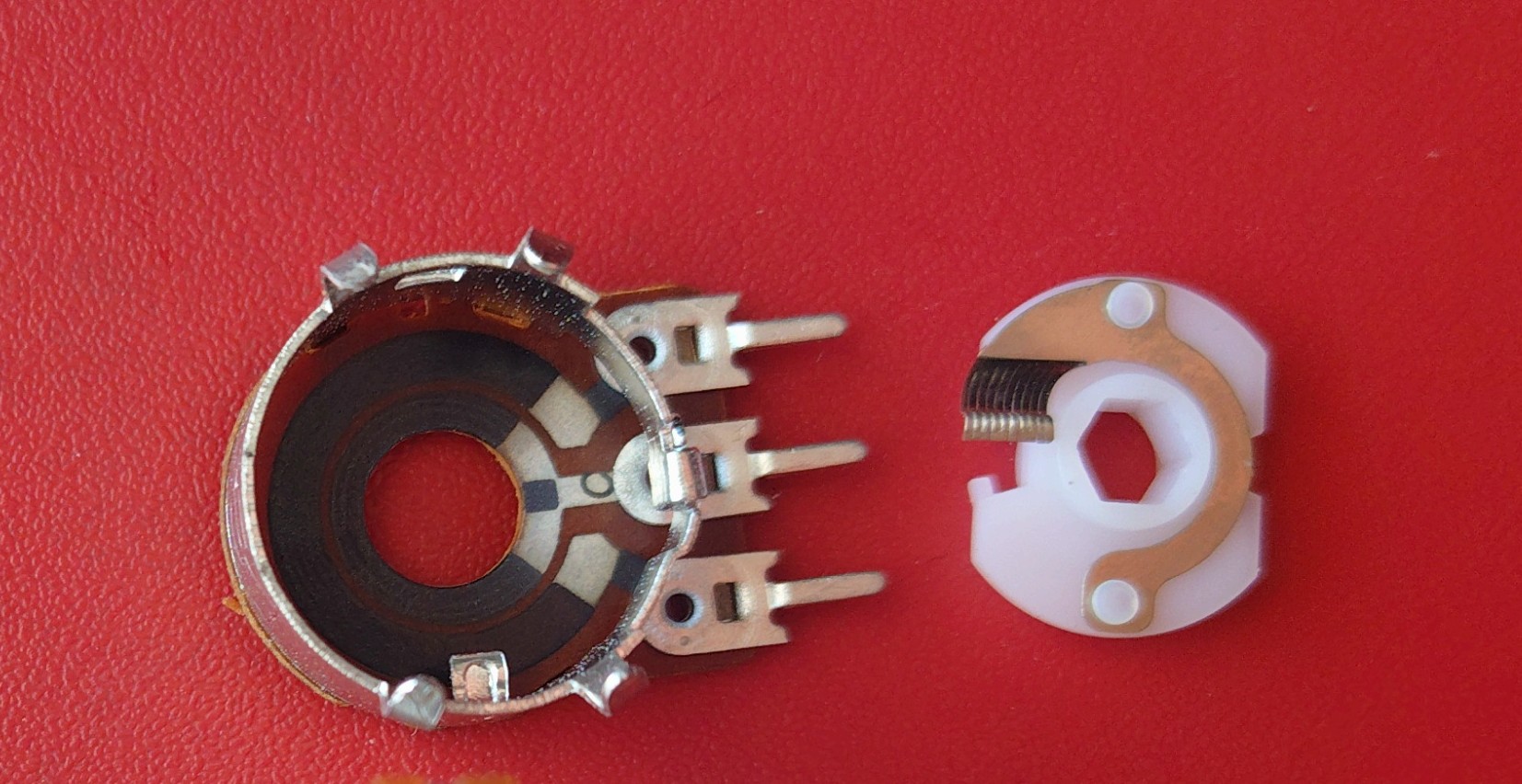
I verified with a multimeter that the linear and logarithmic sides of the potentiometers behave independently and as expected, so the next step was to actually wire them up to do something useful. Important note: besides the shaft length (which tells you whether there will be enough/too much of the pot sticking out of the bass body to cover with the knob), an important parameter when purchasing a potentiometer is its thread length which will determine whether you are able to screw the nut to keep the pot in place. This was not a relevant concern in my design as I reused the existing tone pots from the bass, but it's certainly worth keeping in mind when ordering parts.
Prototyping
There are several options for how to add treble and bass tone controls in passive basses (e.g., here), but the simplest circuit consists of just two capacitors:
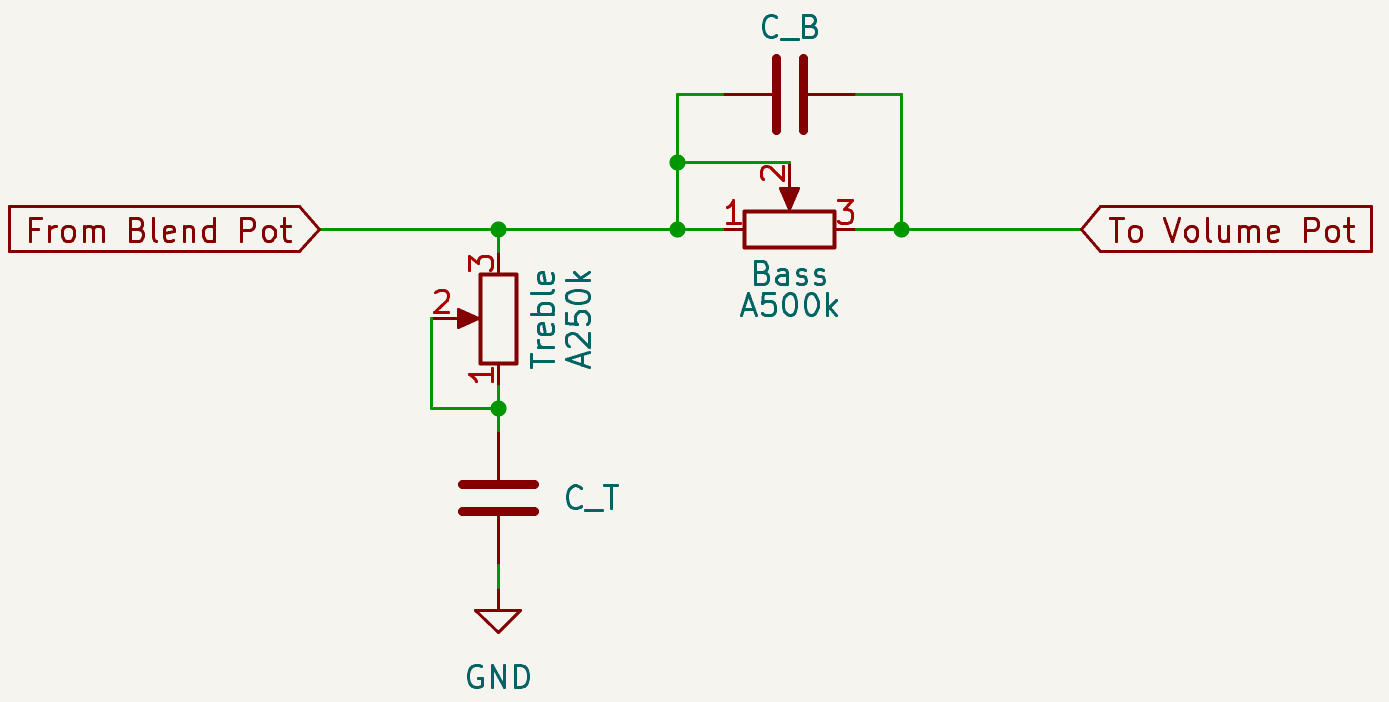
To make prototyping easier, I used JST XH connectors which are a bit bulky for the cavity, but are easy to solder onto prototyping boards due to their 2.5mm pitch. Instead of soldering a capacitor directly, I added female pin headers that made it simple to try different values out:
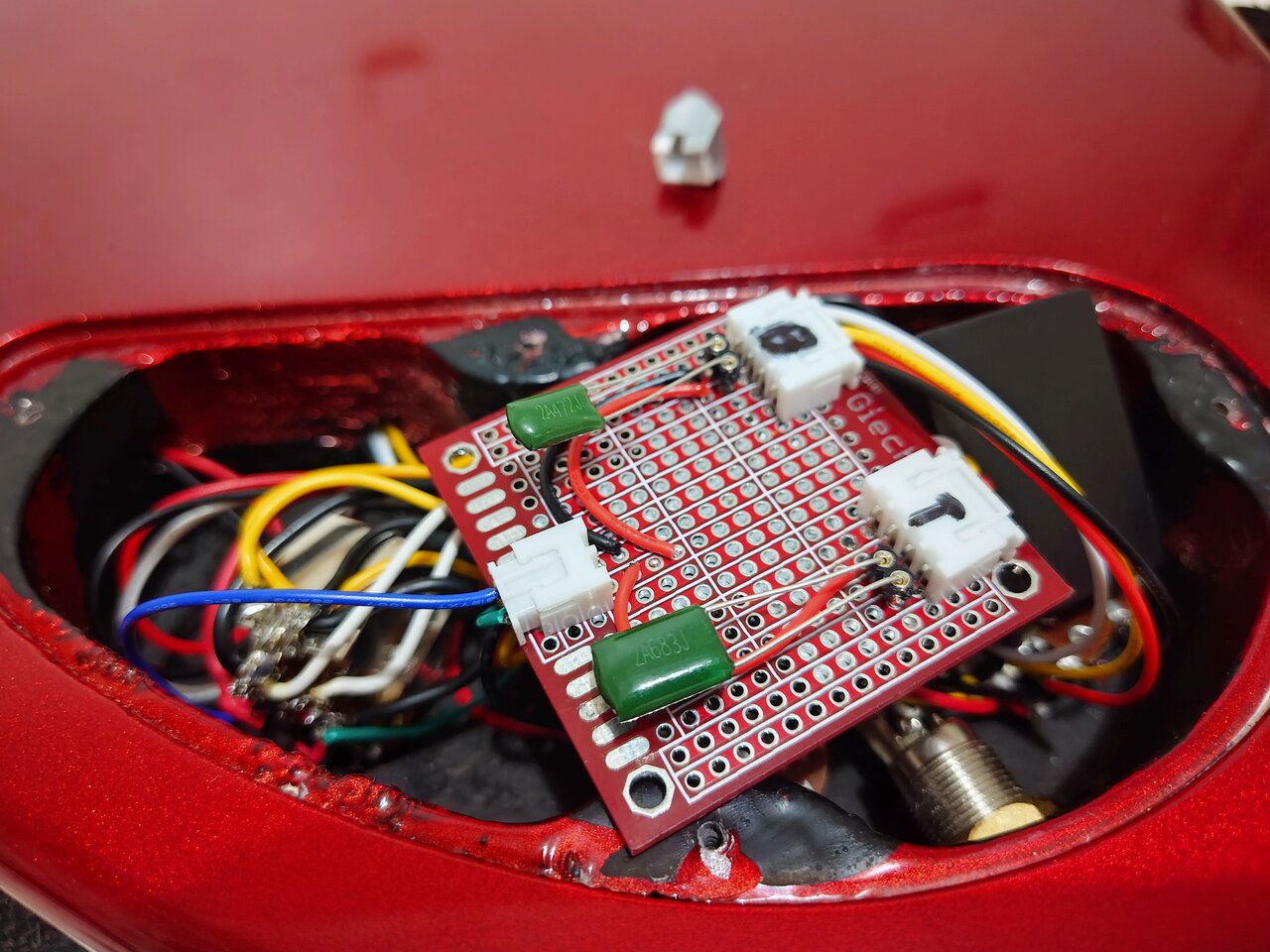
Using the headers also made it straightforward to restore passive-mode functionality without tone controls: all that is needed is a male JST XH header with two shorted pins to connect the blend pot output and volume pot input (shown in the background of the above picture).
Adding Choices
For no good reason other than an itch to play around with electronics, I created a custom PCB in KiCad with a 6-position DIP slide switch that accepts through-hole and SMD components in parallel and in series:
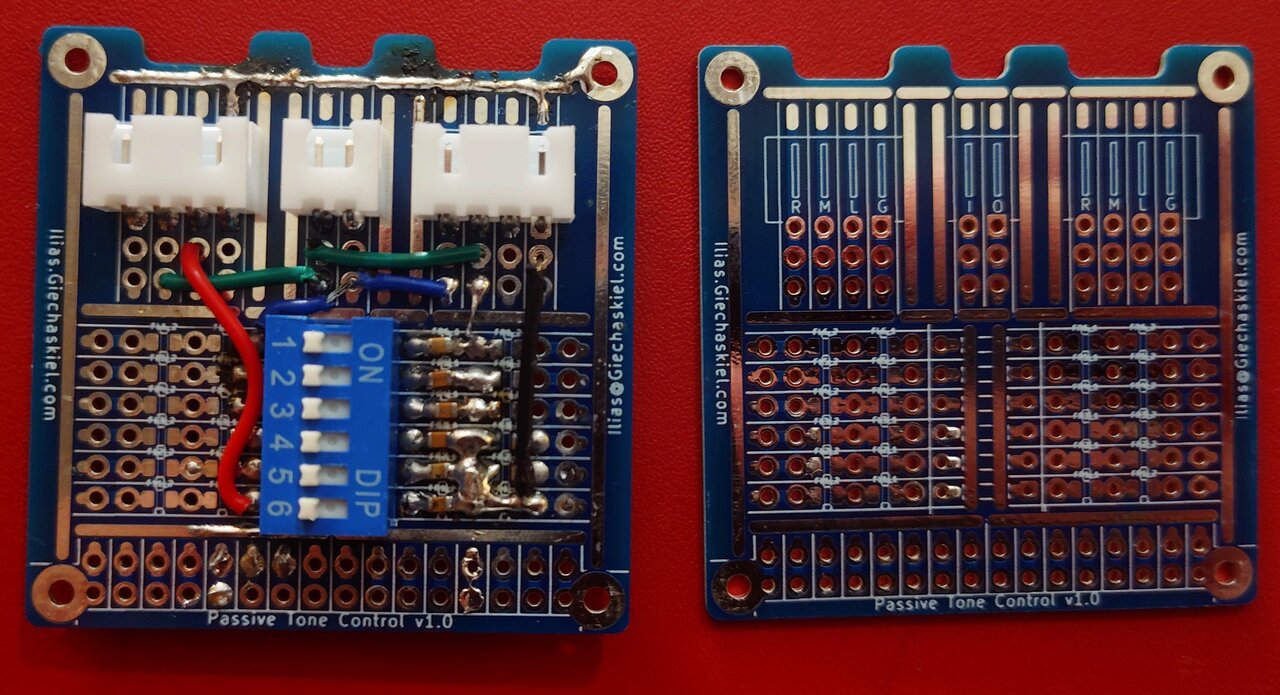
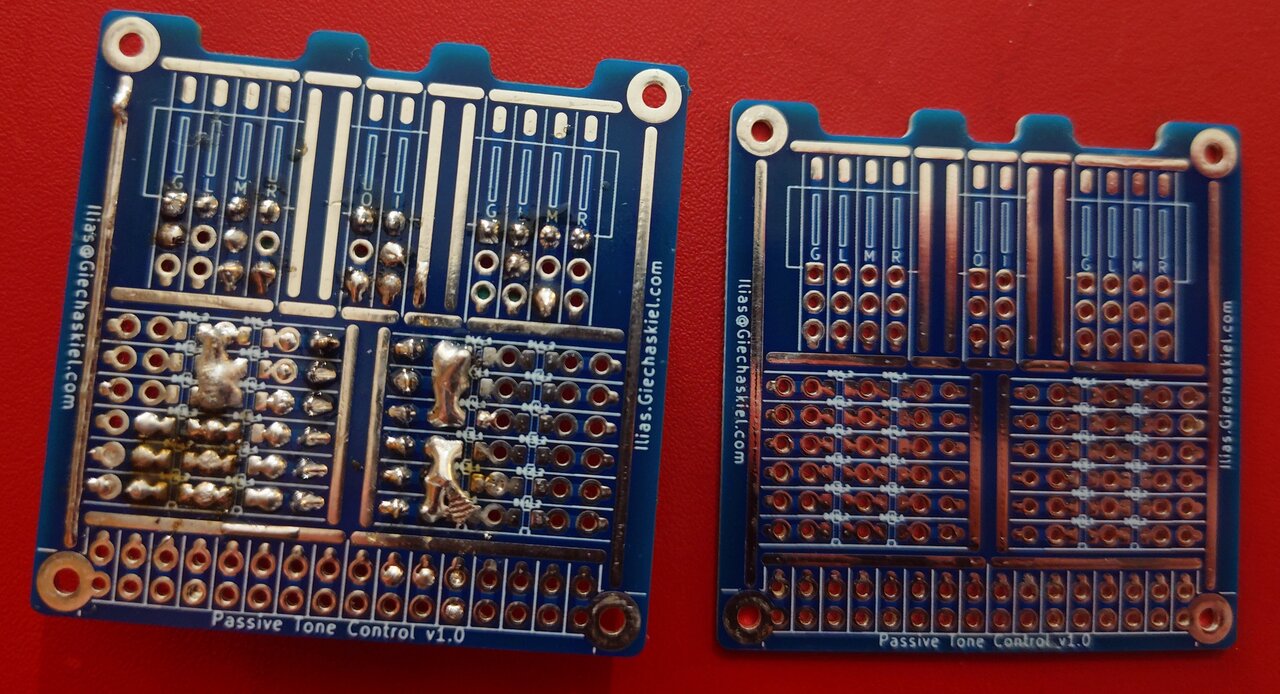
The key goal was to create an extensible design that allows for different configurations both during assembly time (i.e., the exact wiring between the blend output and the volume input) and after populating the board (e.g., which specific capacitor and resistor combination to enable for a given pot, and whether this combination is supposed to act like a low-pass filter or a high-pass one). I also wanted to avoid adding wires as much as possible, so even though through-hole components are supported, I tried to make it possible to complete most of the connections by shorting exposed copper traces. Unfortunately, as I discovered in practice, shorting the adjacent traces ended up being harder than I had anticipated, so I ended up adding a few wires.
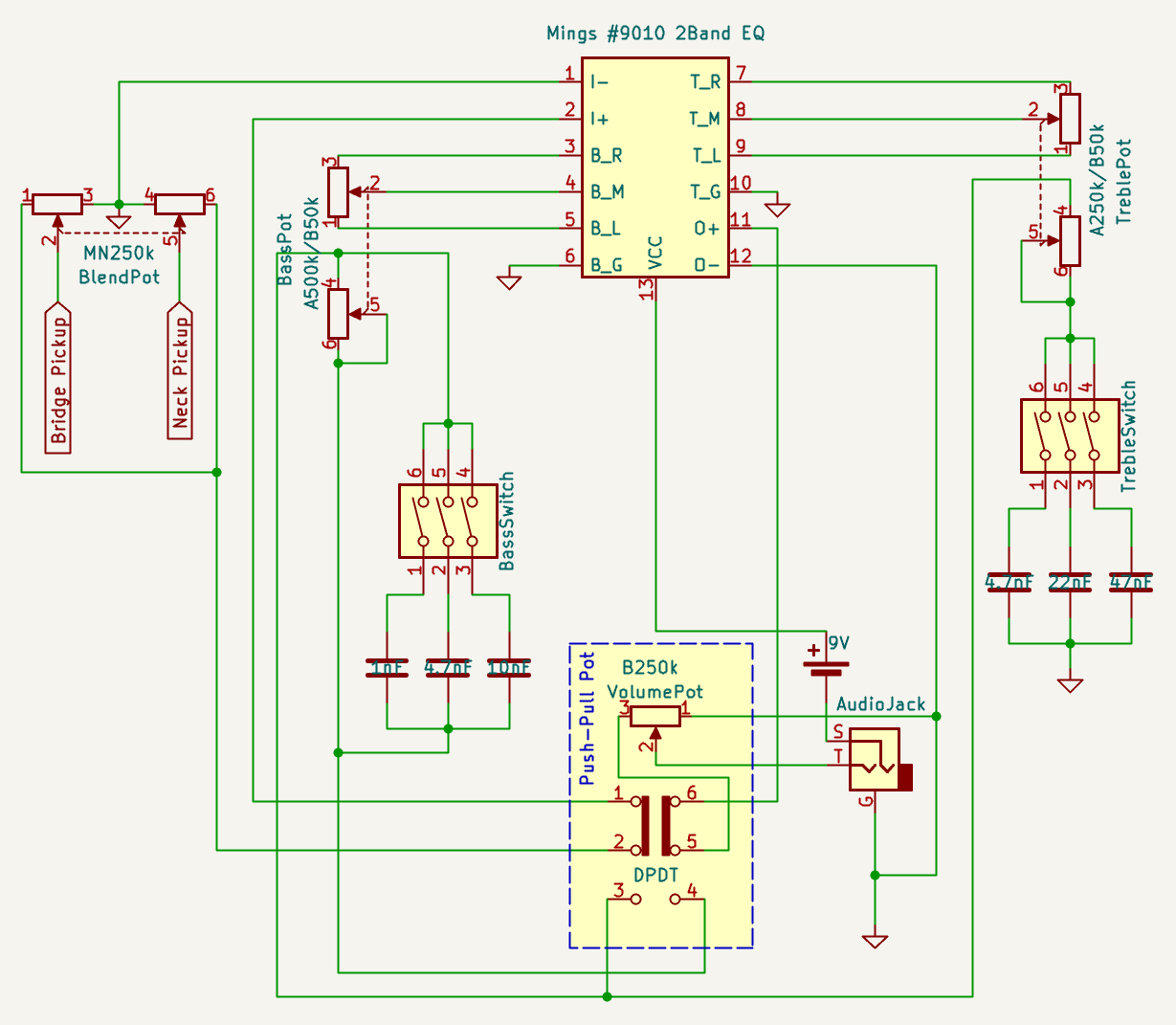
In terms of the concrete capacitor choices, I did not go down the scientific route (e.g., here), but instead tried 18 values from 0.47nF to 220nF during the prototyping phase and chose the ones that I thought covered a wider range of tones: 4.7nF, 22nF, and 47nF for treble and 1nF, 4.7nF, and 10nF for bass. Even though my initial prototyping used film through-hole capacitors, due to space constraints, the final PCB was populated with Multi-Layer Ceramic Capacitor (MLCC) SMD ones. The full schematic looks as follows:
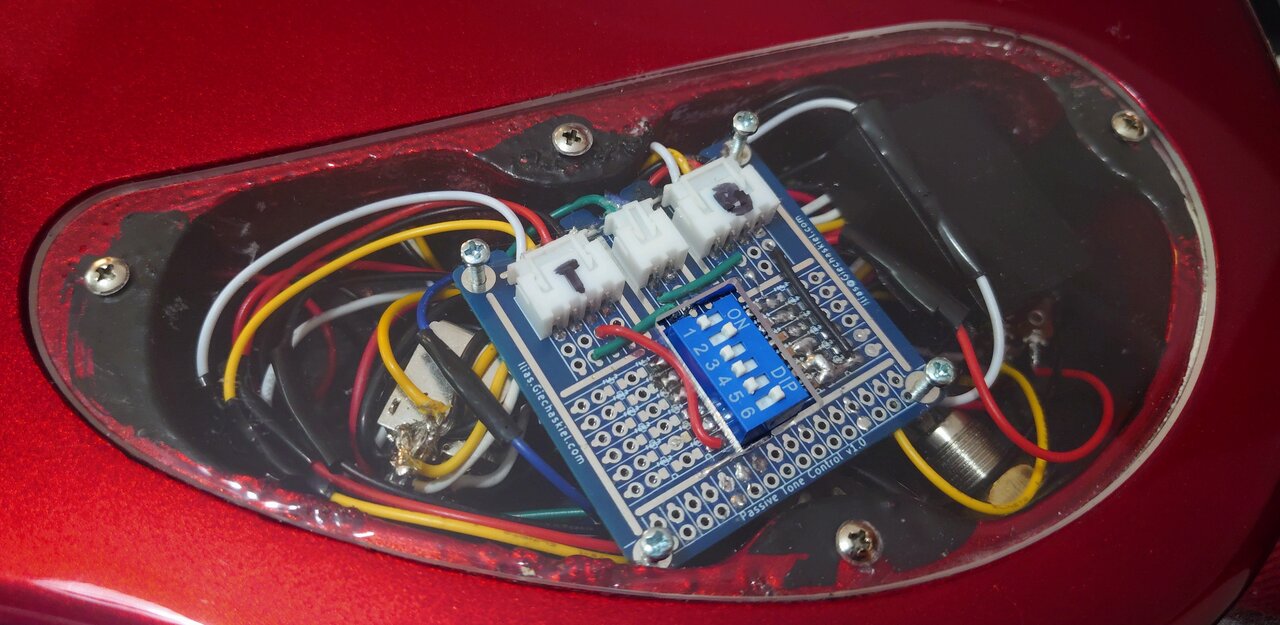
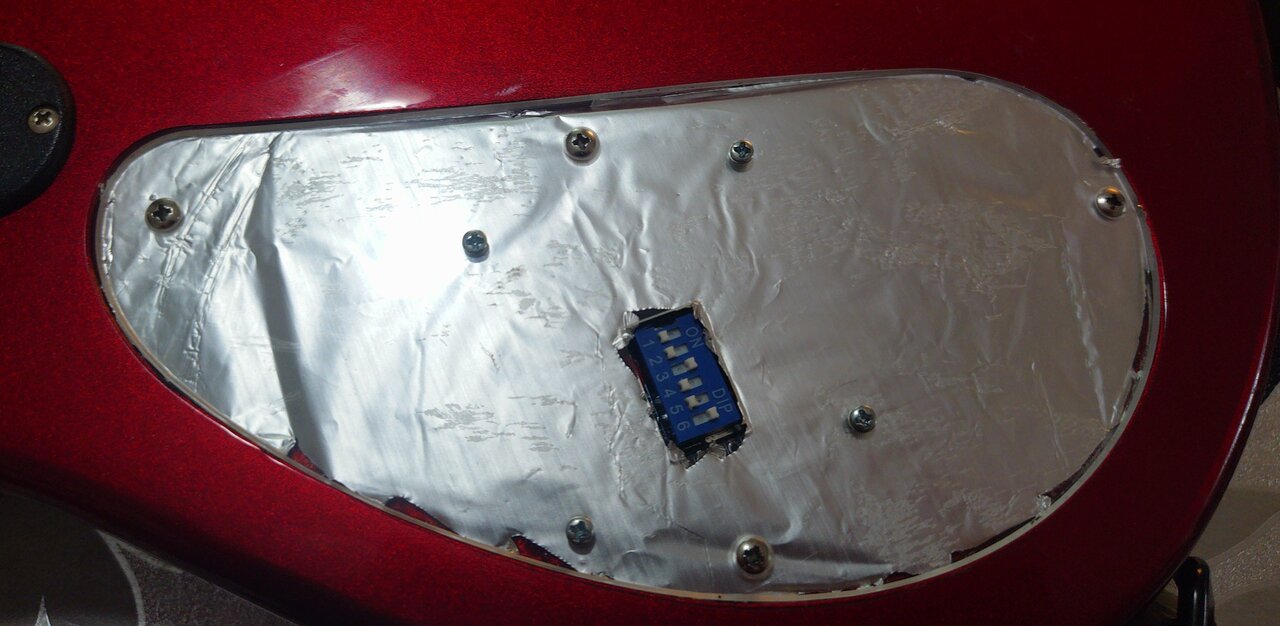
To make full use of the DIP switches, I wanted them to be accessible without opening up the bass every time, so I made a copy of the cavity cover plate with extra mounting holes for the PCB as well as a gap for the DIP switch. As Donner does not sell replacement plates or offer the drawings for the cover, I had to design it myself. I took a high-quality scan of the plate and used Inkscape's edge-detection tool to reproduce it. After simplifying the paths and some manual cleanup, I added the mounting holes for the PCB along with a hole for the switch (despite taking several measurements with a digital caliper, I ended up having to slightly trim one corner of the PCB as the fit in the cavity was very snug). I also covered the back side with aluminum tape that gets grounded via the mounting screws for better shielding. I am not sure how much difference it will make in practice, and it also looks less cool than the see-through version, so I haven't yet made up my mind as to whether I will keep it or not. Here is the end result without and with shielding:
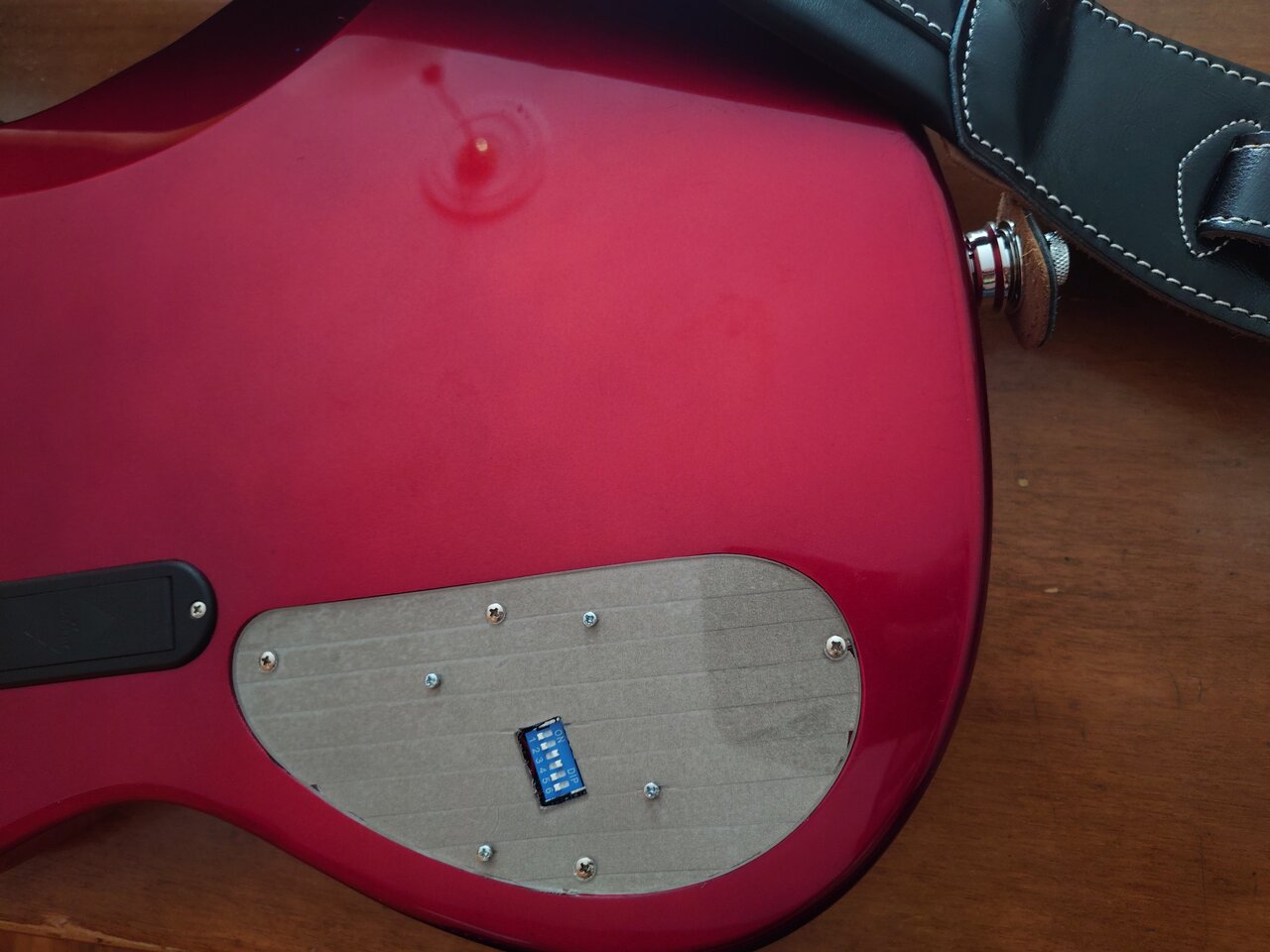
UPDATE 2026/06/29: I ended up replacing the foil with proper adhesive conductive tape, which looks neater yet still provides shielding:
Conclusion
Even though I am sure a more seasoned player would be more particular about the tone they want from the instrument, I have found the tone controls to be usable and useful for me. Moreover, the whole project has been a great learning experience in designing for third-party manufacturing (both for the PCB and for the cavity cover). I also got to explore KiCad scripting, with the PCB itself having been designed in a way that allows for future experimentation with different tone control circuits, even if the shorting idea to avoid wires didn't quite pan out. Overall, I can now safely stop procrastinating on this project and go back to practising instead!